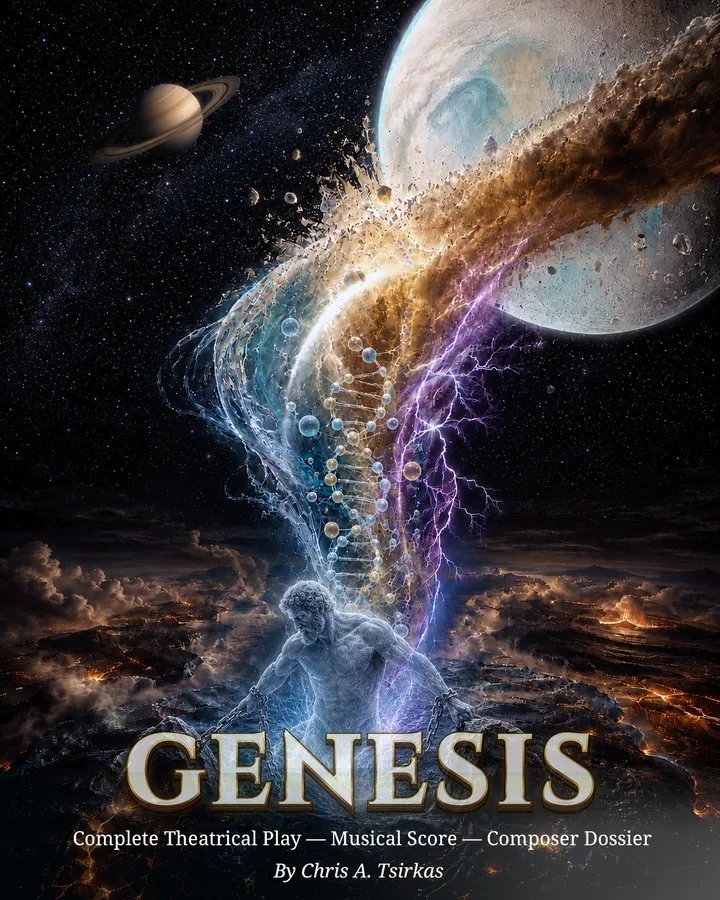
GENESIS
A Promethean Drama for Music Theatre (Libretto and Score)
by Chris Tsirkas
Ebook
FreeAvailable formats: PDF EPUB
All formats included • Instant download • 72-hour link
About This Book
GENESIS — From Planetary Hypothesis to Drama and Music
“GENESIS” began with a question that belongs simultaneously to science and to the oldest territory of human imagination: How does a lifeless world become a living one?
The work presented here is primarily a theatrical and musical response to that question. Its point of departure, however, lies in a speculative scientific investigation of the early Earth: an attempt to imagine, formulate, and examine a planetary event that might have contributed to the environmental and chemical conditions preceding the emergence of life.
That investigation led to the development of a scientific working paper and an accompanying computational framework. Together, they explore a specific hypothesis: that a late, Titan-mass, volatile-rich impactor encountered the Earth approximately 4.1 billion years ago, producing a major environmental reset while contributing water, atmospheric constituents, and chemical feedstocks relevant to prebiotic chemistry. Reduced-order models were developed to examine the internal consistency of this scenario across planetary dynamics, impact partitioning, thermal evolution, atmospheric escape, isotope evolution, noble-gas retention, and post-impact chemistry.
The hypothesis remains provisional. Its calculations do not establish that such an impact occurred, and their calibrated parameters are not measurements of the early Earth. They define a constrained possibility to be tested, refined, or rejected through specialist examination and, ultimately, through higher-fidelity numerical methods. For the time being, the scientific paper and computational framework will not be made publicly available, pending further assessment appropriate to their interdisciplinary scope. They are therefore mentioned here as the intellectual point of departure of “GENESIS”, not as evidence required for the understanding or evaluation of the dramatic work.
The theatre therefore begins where calculation can no longer speak. The physical sequence is translated into the language of Myth. Earth becomes once more “Gaia”; planetary violence assumes the magnitude of the Titans; “Necessity” (“Ananke”) becomes both physical law and dramatic power; and “Prometheus” becomes more than the traditional bearer of fire. Within the symbolic architecture of the play, he approaches the principle of biological continuity itself: the trace that survives the death of one body, passes beyond the limits of the individual, and is received by another.
This transformation does not attempt to convert scientific speculation into dramatic proof. Nor does it require the audience to accept the planetary hypothesis as historical fact. The scientific inquiry asks what might be calculated, constrained, and tested. The theatrical work asks what such processes might mean when translated into human language: creation through destruction, order emerging from violence, continuity overcoming individual mortality, and life arising not outside nature but from within its laws.
Within this dramatic framework, “Necessity” does not signify that the imagined planetary sequence was probable, historically inevitable, or uniquely prescribed by physics. On the contrary, the underlying investigation suggests a narrow and contingent pathway whose realization may have depended upon an extraordinary convergence of circumstances. The drama names that convergence “Necessity” because, once imagined as part of the path from which the living world emerged, every unlikely accident becomes an indispensable link in the chain of its existence. What appears accidental before life arises becomes necessary to every living being that comes after it.
Music provides the final dimension of this transformation. The score does not merely accompany the text or illustrate the action; it gives temporal and emotional form to processes whose natural scales extend from seconds of catastrophic impact to thousands of years of planetary cooling and, beyond them, to geological ages of chemical and biological change.
What belongs to physical description as energy, temperature, mass transfer, atmospheric loss, chemical transition, and time becomes, in music, tension, density, rupture, silence, recurrence, transformation, and resolution. The orchestra does not reproduce the planetary event; it renders perceptible its dramatic pressure: the passage from violence to stillness, from dissolution to structure, and from an apparently lifeless silence to the first possibility of memory.
The resulting work may therefore be understood through four related questions:
The scientific hypothesis asks whether such an event could have happened.
The computational model asks whether its proposed consequences can be made quantitatively self-consistent.
The theatrical play asks what such a genesis means.
The music asks what such a genesis sounds like.
These questions arise from the same act of inquiry, but they do not belong to the same system of proof. No part is intended to substitute for another. The dramatic and musical work stands independently of the eventual scientific fate of the hypothesis from which it began.
One Question, Several Languages:
For millennia, cosmogony belonged principally to Myth, Philosophy, Poetry, and Religion. Modern science gave humanity another language in which to ask how worlds form, how atmospheres change, how molecules organize, and under what conditions matter may cross the extraordinary threshold into life.
“GENESIS” places these languages beside one another, without attempting to erase their differences.
When Prometheus appears on the stage, he does not become an argument for a planetary model. When physical processes are transformed into Gaia, Necessity, Death, or the Chorus of Nights, they cease to function as scientific propositions, and enter the autonomous territory of dramatic meaning. Likewise, the existence of a quantitative foundation does not diminish Prometheus into an equation, Gaia into a planet, or Myth into an ornament placed over scientific machinery.
Theatre does not verify the hypothesis; it reveals another order of consequence.
The catastrophe at the center of the work is therefore more than an imagined collision in the Hadean past. It becomes the primal contradiction from which the drama proceeds: destruction as the condition of creation; death as the bearer of continuity; blind physical law as the distant origin of consciousness; and matter, once incapable of memory, becoming something that can inherit, suffer, speak, and remember.
The deeper subject of “GENESIS” is transition:
From collision to order;
From fire to water;
From atmosphere to chemistry;
From chemistry to inheritance;
From matter to life;
From physical event to human meaning;
And, finally, from calculation to word and sound.
The scientific hypothesis may eventually survive and published, change substantially, or be falsified by better evidence. That possibility belongs naturally to the inquiry from which the work arose. The artistic question neither depends upon nor disappears with any future scientific verdict:
How does a world become capable of remembering itself?
“GENESIS” is an attempt to ask that question through Myth, theatre, and music—while preserving, beneath them, the distant trace of the scientific question from which they emerged.
Accompanying material
The theatrical and musical work presented in this document forms part of the wider “GENESIS” project. The speculative planetary scenario from which this work originated has also been explored through a separate scientific working paper of a falsifiable quantitative hypothesis and a computational framework, including quantitative models, numerical experiments, and an examination of the hypothesis’s limitations. These research materials are not publicly distributed at Zenodo due to the paper’s speculative nature, but remain available for exploration at my GitHub account:
https://github.com/ChristosTsirkas/genesis-earth-hadean-titan-impact-model
https://github.com/ChristosTsirkas/genesis-earth-hadean-titan-impact-model/tree/main/docs
Additional, computer-generated support files for the music of this project can be accessed at:
https://github.com/ChristosTsirkas/genesis-earth-hadean-titan-impact-model/tree/main/music
A rendered realization of the “GENESIS” musical score is also available online, allowing the musical component to be heard independently of a staged performance.
Listen to “GENESIS” on SoundCloud:
https://soundcloud.com/chris-t-331652374
Book Details and Delivery
GENESIS is available from eBookIt as a direct digital purchase from an independent author or publisher. After checkout, eBookIt emails secure download links so you can retrieve the files without waiting for shipping or creating a public bookstore account.
Use this page to confirm the author, subject category, available formats, sample media, and price before you buy. Ebook listings may include PDF, EPUB, and MOBI files; audiobook listings may include downloadable audio packages and samples when supplied by the author.
If you are browsing related topics, start with the category links above or the related reading below. They help readers move between similar independent ebooks and audiobooks while keeping each title's purchase page clear and focused.
ISBN: 9781456689469